Marie Clay writes about developing the child’s ‘literacy behaviours’. For example, ‘directional behaviour’:
Complex movement patterns to be learned include:
> attending to a left page before a right page
> moving from the top of the page downwards
> moving left to right across a line of print
> returning back to the left of the next line
> using the spaces to control attention to words
> attending left to right across a word
> knowing how and where to find what the teacher calls the ‘first letter’ or the ‘last letter’
> and (ultimately) scanning every letter [grapheme] rapidly in sequence from first to last without lapses.
p6 ‘Literacy Lessons Designed for Individuals: Part Two’ Marie M Clay italics added
Many children master directional behaviour with no real difficulty. But not all. I have observed children in Year 6 and beyond, who still seem to be struggling to grasp the concept of moving from left to right across words.
During my years as a literacy intervention teacher, I have worked with a significant (if small) number of children who have experienced considerable confusion in this behaviour. At the beginning of an intervention, a child may regularly decode a word by starting with the final letter (for example, reading ‘on’ instead of ‘no’). In my initial assessments, my records have shown that word attempts can be regularly frustrated because a prominent letter within word may grab the child’s attention and mistakenly become their starting point. Because the child has failed to get to grips with consistently working from left to right – the errors can remain uncorrected (particularly if they make sense in the context of the passage being read).
Insecure directional behaviour can also hamper a child’s grasp of phonics. When a child is not in control of directional behaviour, they are likely to muddle the letter order in digraphs (two letters, one sound, e.g. ‘ar’ in park) and trigraphs (three letters, one sound, e.g. ‘igh’ in light) and, consequently, face more frustrations in their attempts to read and spell words.
What scaffolding might be put in place to support a child’s directional behaviour?
Here are a few suggestions:
- When reading aloud, model moving ‘a clear, pointing finger’ under the words, tracking from left to right;
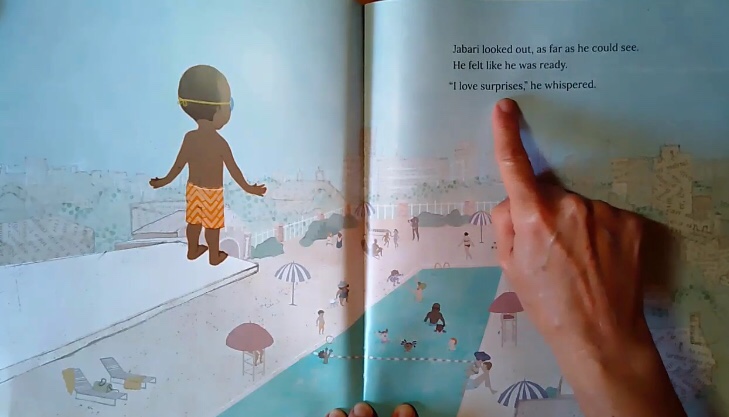
- Encourage the child to do the same as they read (this can also be useful in helping the child match one spoken word to one written word);
- ‘Sometimes the child’s pointing covers the words he is trying to read. Use a simple instruction like “Remember to point here under the words.”‘;
- ‘For the early stages… select texts that use strong clear print that is well-differentiated from the pictures and the punctuation is normal. Preferably the text begins toward the left of the page and the punctuation is normal. As the child gains control over direction some variations in layout can help the child to become [more] flexible… in his approach…’
- When a child shows confusion about where to start when decoding a word, use the simple prompt “Always start with the first letter.” (pointing, if necessary);
- Use the Finger-framing and/or Slow Reveal techniques (use sparingly, always remembering to encourage the child’s independent problem-solving).
If finger pointing is allowed to persist it may become a prop that gets in the way of fluent reading. So as soon as directional responding becomes consistent the teacher can begin to discourage pointing with the finger when reading familiar text…
The child is only ready to discard the use of the finger if the eyes and the brain have learned how to search across print word by word in appropriate ways. To coordinate several skills while solving some new problems on a difficult text a child who has not needed to point for some time may begin doing so again…
p12 ‘Literacy Lessons Designed for Individuals: Part Two’ Marie M Clay
How might you remove this scaffold, when the child has nailed directional behaviour and is consistently working from left to right?
- Use a progressive prompt to gradually wean the child away from the hand-eye tracking, encouraging them to use their eyes to track, “Try the next sentence… the next page… this book… without using your finger.”
- Affirm their attempts, “Your eyes worked really well on their own!”, “Well done! You only needed to use your finger for that tricky word!”
- Allow plenty of opportunity for practice and over-learning.
Control over directional things can be taught by demonstration and with few words. Teacher talk can easily create confusions. One crisp demonstration might lead to learning after one trial but it is probable that the crisp demonstration will need to be repeated on other books and in other settings…
Before long the learner will come to control the directional schema and will allocate only a fraction of a second to any decision about direction.
p7 ‘Literacy Lessons Designed for Individuals: Part Two’ Marie M Clay
Post Lockdown, I hope to film practical examples of these strategies in use, as child and adult read together. Watch this space…

