
(A series of 6 short posts, where I think out loud about where I’ve been, where I am, and where I want to be.)
In this period of unemployment, I have time on my hands. Am I using it wisely? Was Carol Cotton right in her ‘it-is-what-it-is’ advice to not, ‘waste time trying to “go deep” into analysis of something or figure out how to change or get around it.’? Or was John Stuart Mill speaking truth when he encouraged men (and women) ‘to use his [her] mind on the subject‘ and ‘form an opinion‘?
“Let not any one pacify his conscience by the delusion that he can do no harm if he takes no part, and forms no opinion … because he will not trouble himself to use his mind on the subject.”
John Stuart Mill’s 1867 inaugural address, University of St. Andrews
In last Thursday’s Herefordshire Council Cabinet meeting, Councillor Diana Toynbee opened the discussion of the report into Herefordshire Children’s Services. As she outlined some of the progress that had been made since the inspection and the foundations that are being established, Councillor Toynbee stressed,
“This work is all about relationships.”
Herefordshire Council Cabinet 29/09/22 (24:37)
Last month, a tweet introduced me to an article by Dr Jamila Dugan, ‘Co-Constructing Family Engagement’. The insights she shares feel like a breath of fresh air.
‘All educators wish to create strong relationships with the families we serve. But we may not realize that some of the common practices we use to build those relationships actually get in the way of true partnership…
Dr Jamila Dugan, ‘Co-Constructing Family Engagement’
Dr Dugan uncovers the factors that can prevent families from fully engaging with schools,
‘Families who have been marginalized have little reason to trust educators. Not because we have bad intentions or wish to do wrong by children, but because our system has shown time and time again that schools can be places where students at the margins can experience great harm.’
Dr Jamila Dugan, ‘Co-Constructing Family Engagement’
She holds a safe space for educators and families, where it’s okay to not have all the answers, while encouraging us to work together to build two-sided relationships, where everyone’s voice is heard and valued.
‘There is power in educators acknowledging that they have not yet figured out how to best support each or all the students in front of them. We don’t always know how to hold high expectations, provide support, and nurture positive attitudes, and because of these gaps we are prone to make mistakes. This is why we need family partnerships. This is why relationships matter from the beginning.
The underlying belief is that to best support a child, we must get to know each other, create a shared picture of student goals and needs, and engage in collaborative activities like problem solving.
…there’s a power in admitting you don’t have all the answers.’
Dr Jamila Dugan, ‘Co-Constructing Family Engagement’
There was a time when I thought I had the answers. I remember extolling the virtues of a certain reading intervention programme, quoting the ‘facts’ and ‘figures’ I had imbibed, intent on ‘proving’ its success rate to anyone who would listen. Before I even began my in-service ECaR training, I religiously believed and proclaimed the ‘research evidence’ – without engaging in any level of critical analysis. It was only through my husband’s academic studies, that I was introduced to aspects of critical thinking which continue to serve me well.
Conversations are inevitably one-sided when somebody is convinced that they hold the answers. At the beginning of my period of self-employment as a literacy intervention teacher (2013-2019), my training and experience had already equipped me with a significant amount of knowledge and understanding of how children learned to read and write, and what I could do to support their learning process. But I didn’t have all the answers and there’s little evidence to show that my methods opened up collaborative, problem-solving conversations with families and schools.
Take my contract, for example:
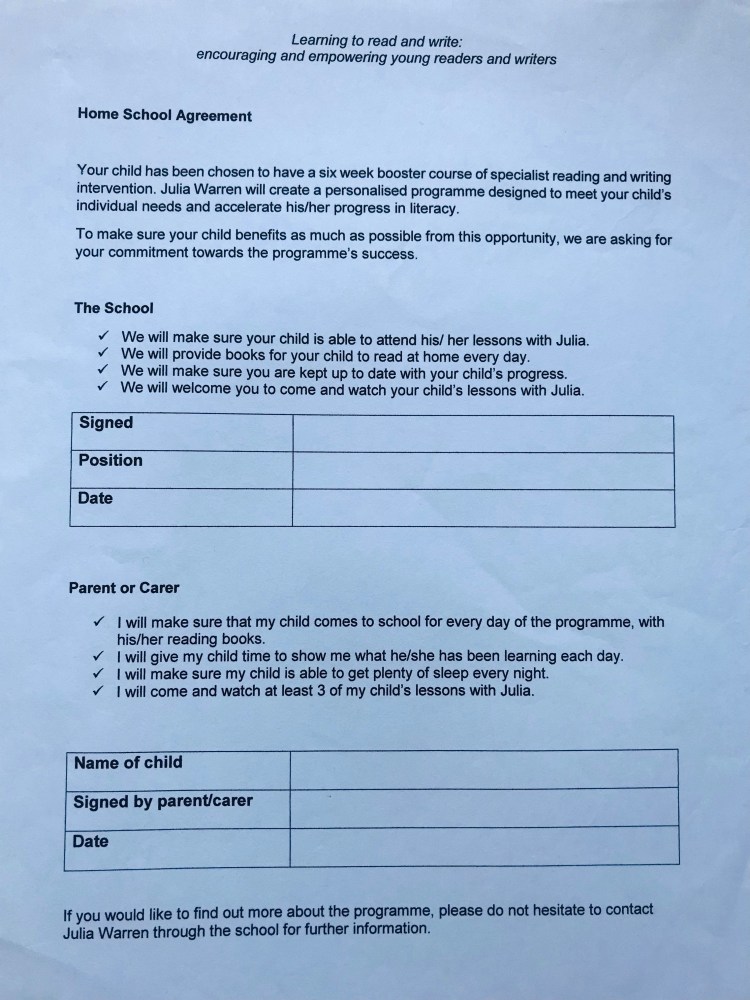
There’s not a lot of trust involved in getting somebody to sign a contract to agree to do what you say, when you say it, is there?
‘Your child has been chosen to have a six week booster course of specialist reading and writing intervention.’
Parents: Why?
‘Julia Warren will provide a personalised programme designed to meet your child’s individual needs and accelerate his/her progress in literacy.’
Parents: Who’s Julia Warren? What does she know about my child’s ‘individual needs’? What if I disagree that ‘accelerating’ my child’s ‘progress’ is in their best interests?
How can families and educators build two-sided conversations, where we can actively learn from each other and properly collaborate to deliver the best outcomes for everyone?
Dr Jamila Dugan advocates the power of small, meaningful interactions in establishing trust and mutual respect. She promotes authentic dialogue, where families and educators can grow to understand each other’s expectations and priorities.
‘When families and educators do come together and brainstorm answers around a central question in a way that nurtures dialogue and shared ownership, the solutions are always richer. And when we create those opportunities with families who have been othered or minoritized in mind, we have more opportunities to increase inclusivity.
Dr Jamila Dugan, ‘Co-Constructing Family Engagement’
I’m uplifted by the possibilities of all that Dr Jamila Dugan suggests.
 Read with Julia
One thought on “‘It is what it is.’ (Part 5/6)”